

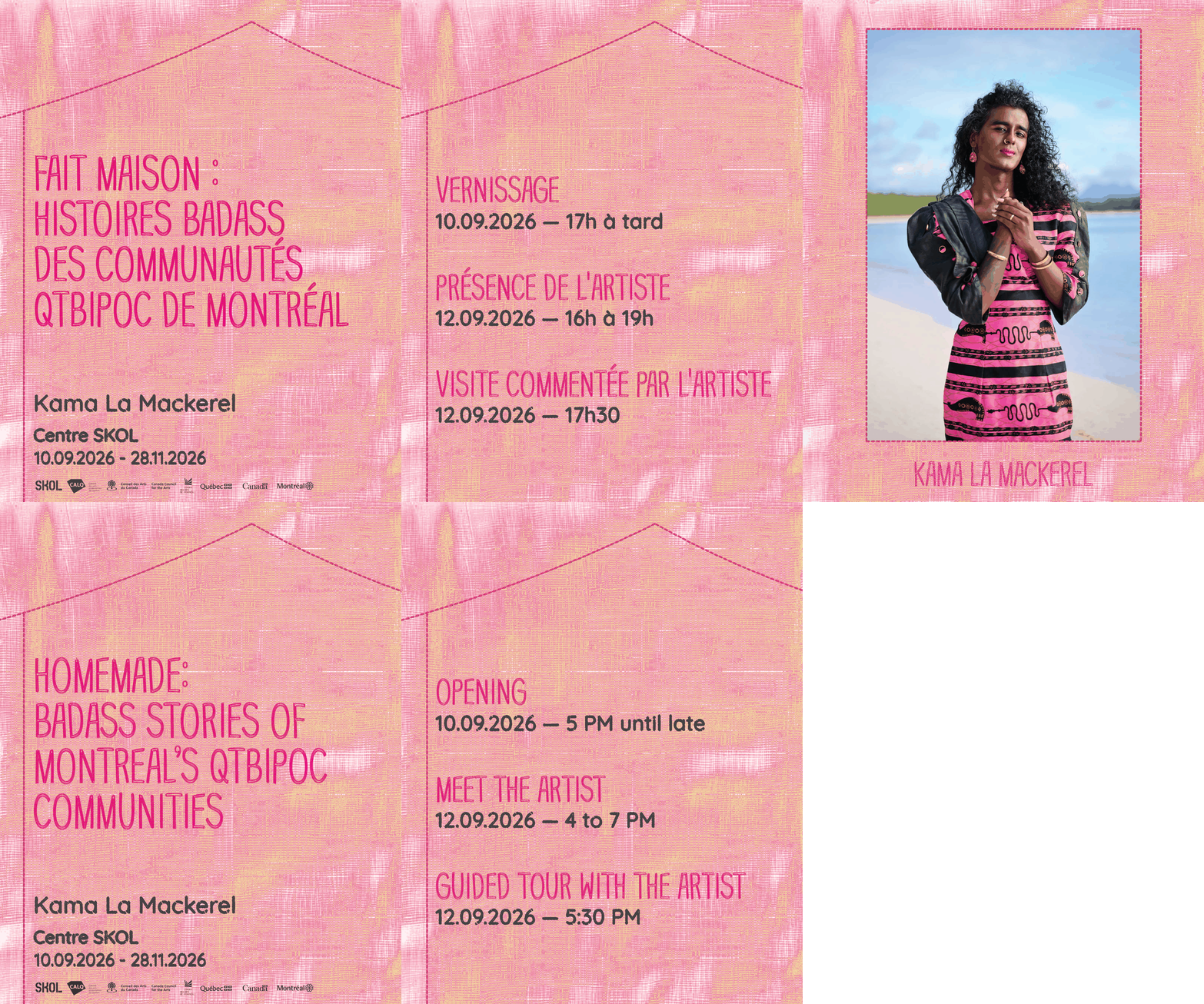
Homemade: Badass Stories from Montreal’s QTBIPOC Communities
A solo exhibition nourished by collective actions
September 10th–November 28th, 2026
Meet the Artist and Guided Tour at SKOL
Saturday, September 12th, 4pm–7pm (tour at 5:30pm)
***
What remains of the spaces we built together once the evenings are over, the venues have closed, the collectives have dispersed, and our own memories begin to slip away?
With Homemade: Badass Stories from Montreal’s QTBIPOC Communities, Kama La Mackerel looks back on nearly fifteen years of artistic practice and community-based creation within Montreal’s QTBIPOC communities—queer, trans, Black, Indigenous, and people of color.
Drawing on personal and collective archives, the exhibition brings together DIY posters, photographs, videos, banners, clothing, music, publications, and objects. These artifacts tell the stories of projects, events, friendships, and struggles, as well as creative spaces built with limited resources but plenty of ingenuity, hard work, and care.
Yet Homemade does not seek to reconstruct a definitive history. Fifteen years later, some memories remain intact; others have become blurred or faded. Some stories are extensively documented; others survive almost exclusively in bodies, sensations, and narratives. To prepare the exhibition, La Mackerel revisited several people who had been part of the Qouleur collective. Their memories intersect, complement one another, and sometimes contradict each other. These discrepancies are also part of the archive.
This constellation brings together several projects that have shaped La Mackerel’s practice and the communities that supported them. In 2013, résistance // résidence transformed an individual’s precarious migratory situation into an act of collective solidarity. GENDER B(L)ENDER became a counterpart for five years, it became an open queer stage where hundreds of performances were presented, experimented with, and discovered. The Self-Love Cabaret explores care as a curatorial practice: paying, documenting, welcoming, and nurturing artists. Qouleur became an artistic and political space by and for queer and trans people of color.
All these projects were built with limited resources. Apartments became meeting places; cafés, stages; meals, community infrastructure. Friends became technicians, photographers, graphic designers, or organizers. Where existing spaces were insufficient, communities created the conditions for their own emergence.
The exhibition also shows what this work entails: volunteer work, precariousness, burnout, the disappearance of places—but also of knowledge that becomes difficult to pass on when projects come to an end. Over time, the objects that remain change in function and status. A poster becomes an archive. A piece of clothing becomes a banner. A collectively produced CD finds a new life in a listening station. A documentary video becomes a testament to a world that no longer exists in the same way.
At the heart of the exhibition, these questions take the form of a large textile house that visitors can enter. Covered in fabrics and collected words, it houses a communal altar as well as photographs of a community meal held in August 2026. It revives the practices of hospitality and gathering that run throughout the exhibition. Neither a monument nor a nostalgic reenactment, it evokes apartments, cafés, galleries, crowded tables, and borrowed spaces where, for a few hours, it became possible to form a community.
In Trans Affirmations, saris passed down from mother to child become banners addressed to trans women of color. Family memory, political affirmation, mourning, and tenderness converge here: gentleness, too, becomes a form of resistance.
Homemade thus presents an exhibition where archiving is as much about preserving as it is about reactivating, narrating, and passing on. Writing, voices, photographs, textiles, and objects all respond to the same question:
What does it mean to “make a home” when a home does not yet exist?
Perhaps it means creating, together, a place vibrant enough to welcome those who came before us—and open enough for others to still find their way there.
***
Biography
Kama La Mackerel is a Mauritian-Canadian multilingual writer, visual artist, performer, educator, literary translator, and ritualist. Her work and life are rooted in a deep commitment to love, justice, and individual and collective empowerment.
Nourished by insularity, oceanic memory, trans poetics, Creolity, decolonial ecologies, and ancestral Indo-African spiritualities, her interdisciplinary practice reconfigures dominant aesthetics to bring forth decolonial and queer/trans vocabularies. Through poetry, textiles, sound, video, installation, and performance, she engages with interstitial spaces—between languages, bodies, disciplines, and territories—as sites of memory, resistance, and transformation.
A recipient of the Canada Council for the Arts’ Joseph S. Stauffer Award in the visual arts, Kama has presented her work in galleries, museums, festivals, and creative spaces in Canada and internationally. She is the author of *ZOM-FAM* (2020) and *Indrazaal and the Quest for the Ocean* (2023).